Construction projects have always been difficult to explain from the outside. Weeks of work can appear as if “nothing has changed” to clients, investors, funders or remote stakeholders. At the same time, project teams need reliable evidence of what happened on site, when it happened, and how each stage of work progressed.
This is where construction time-lapse cameras have evolved far beyond a final marketing video.
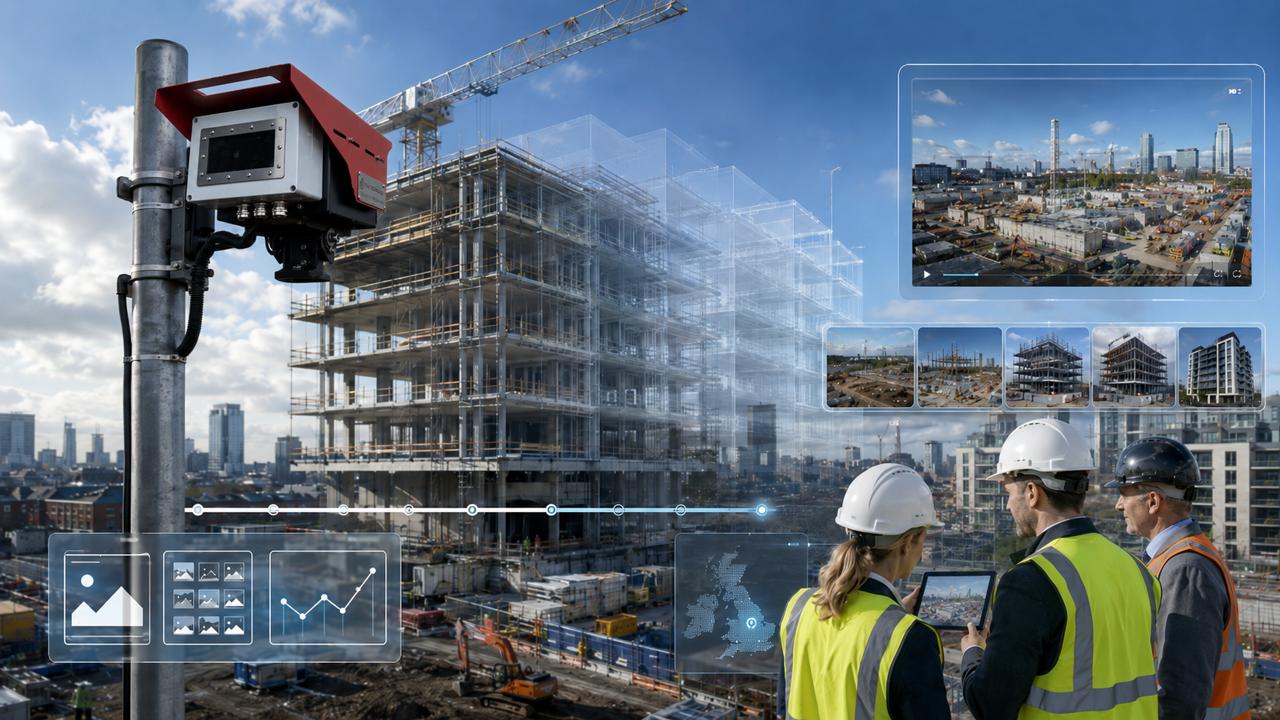
Today, a professional time-lapse system is not simply a camera looking at a project site. It is a visual monitoring tool, a documentation archive, a reporting assistant, a stakeholder communication channel and a long-term marketing asset. When combined with cloud storage, live view, AI-enhanced image processing, weather data, BIM/BI integrations and automated video generation, time-lapse becomes part of the project’s digital infrastructure.
Here are five key benefits of using time-lapse cameras on modern construction projects in the UK.
1. Better Project Visibility From Anywhere
Good construction decisions depend on visibility. But regular site visits can be expensive, time-consuming and difficult to arrange for every client, consultant, investor or stakeholder involved.
A construction time-lapse camera gives project teams a consistent visual record from a fixed viewpoint. Instead of relying only on written reports, scattered phone photos or occasional site visits, project managers can open a live view or photo archive and immediately understand what is happening on site.
This is especially valuable for developers, contractors and asset owners managing several projects at once. A single online platform can help teams compare progress across different locations, check whether key milestones are moving in line with the programme, and identify issues before they become larger delays.
For clients, contractors, investors and project teams, the benefit is simple: everyone sees the same reality. Progress becomes visible, shareable and easier to discuss.
2. Stronger Documentation for Claims, Inspections and Accountability
Construction projects generate thousands of decisions, changes and dependencies. When a question, delay or dispute appears months later, memory is not enough. Teams need objective evidence.
Time-lapse cameras create a chronological visual archive of the entire project. Every image is connected to a specific date and time, making it easier to review site conditions, confirm completed work, check the sequence of construction stages, and support discussions around claims or delays.
This is useful for:
- insurance claims;
- client and funder reporting;
- contractor and subcontractor coordination;
- payment validation;
- quality assurance;
- inspections;
- dispute resolution;
- progress evidence for internal and external stakeholders.
Unlike random site photos stored across different phones, folders and messaging apps, a structured time-lapse archive keeps the project history organised. With timeline and calendar tools, teams can return to a specific day, compare two stages, zoom into details and share selected images with the people who need them.
In modern construction, good documentation is not just an administrative task. It is risk protection.
3. Faster Progress Tracking and Earlier Problem Detection
The biggest value of time-lapse is not always the final video. It is the ability to track progress while the project is still active.
Automated daily, weekly and monthly time-lapse clips help project managers quickly review what has changed on site. This makes it easier to spot patterns that are hard to see in real time: slow-moving zones, idle equipment, repeated interruptions, weather-related delays or work areas that do not match the planned sequence.
Modern visual monitoring can also support comparison with drawings, BIM models, drone panoramas and business intelligence dashboards. When visual data becomes part of the reporting workflow, project teams can move from subjective updates to evidence-based progress reviews.
The result is better decision-making. Teams do not need to wait until the next formal meeting to realise that something is falling behind the programme. They can see it, discuss it and respond earlier.
4. Clearer Communication With Clients, Investors and Stakeholders
Construction reports are often too technical for non-construction audiences. Drawings, programmes and spreadsheets are important, but they do not always communicate progress clearly.
Time-lapse helps close this communication gap.
A short visual update can show days, weeks or months of work in seconds. It makes complex construction stages easier to understand for clients, investors, funders, local authorities, future occupiers, marketing teams and the wider public.
This is particularly important for large, high-value or public-facing projects, where many people need confidence that work is moving forward. A well-produced progress video can be used in investor presentations, public updates, stakeholder meetings, newsletters, websites and social media.
Instead of explaining progress only with words, teams can show it.
That creates trust.
5. A Powerful Marketing and PR Asset After Completion
Every construction project tells a story: the empty site, the groundworks, the foundations, the structure, the façade, the fit-out and the final result. Time-lapse turns that story into a visual asset that can continue working long after the project is complete.
A professional construction time-lapse video can be used for:
- project launches;
- property marketing;
- investor relations;
- tenders and proposals;
- company portfolios;
- social media campaigns;
- event presentations;
- website case studies;
- PR materials;
- client communications.
For developers, contractors and property companies, this matters because trust is visual. Potential clients want to see what a company has delivered, not just read about it. A high-quality time-lapse video demonstrates capability, scale, consistency and technical professionalism in a format that is easy to watch and easy to share.
With AI-enhanced post-production, stabilisation, brightness smoothing, bad-frame detection, colour correction and high-resolution output, the final result becomes more than documentation. It becomes a polished brand asset.
Why Modern Time-Lapse Is More Than a Camera
The old idea of time-lapse was simple: install a camera, collect images and create a final video.
The modern approach is different.
A professional time-lapse system can include:
- live site view;
- unlimited high-resolution photo archive;
- automated daily, weekly, monthly and full-project videos;
- stage comparison tools;
- weather data linked to images;
- mobile access;
- team permissions;
- BIM and BI integrations;
- drone panoramas and additional media uploads;
- AI-enhanced video production;
- easy sharing with clients, consultants and stakeholders.
This makes time-lapse useful not only at the end of the project, but every day during construction.
A Practical Tool for Every Stage of the Project
Construction time-lapse is most useful when it works quietly in the background throughout the whole project.
During the build, it helps project teams check progress, keep clients updated and maintain a clear visual record of what happened on site. After completion, the same material can be turned into project videos, case studies, social media content and presentation assets.
For UK developers, contractors, consultants and property teams, the value is simple: fewer assumptions, clearer communication and a better way to show the work as it happens.
Whether the priority is reporting, documentation, stakeholder updates or marketing, a well-managed time-lapse system gives the project team one reliable visual source to work from.